
Here’s are steps that need to execute before start executing Data Transformation
1. Delete Data and SID On Cube (Destination)
2.Delete Index (Destination)
3.Delete Aggregate (Destination)
Here’s are steps that need to execute before start executing Data Transformation
1. Delete Data and SID On Cube (Destination)
2.Delete Index (Destination)
3.Delete Aggregate (Destination)

What is the secret recepies for making a good and reliable ERP system ?
and the answer is…
Centralization of Master Data
All you have to do is to have one Centralize ‘Master Data’ and the next steps, which is, how you have to build ERP system is becoming less important (critical).
Any implementation model, In-House, working with Independent Software Vendor (ISV) or make use of well known ERP application is not obstacle free, every model has it’s own challenge.
But..without single (centralize) Master Data, you are not going anywhere.
The next step in SAP BW after Initial (INIT) and Full of Logistic (LIS) Data Extaction (with InfoPackage) from SAP R/3 to Persistance Storage Area (PSA), is to load very large data (2LIS_11_VAKON) from PSA to DataSource Object (DSO). This data source is one of the biggest Datasource we have on our SAP BW 7 system.
Seconds after we start the extraction from PSA to DSO using Data Transfer Process (DTP), it suddenly throw an ABAP dump on first Package.
This a log file from ST22 ABAP dump Analysis:
----------------------------------------------------------------------------------------------------
Runtime Errors        UNCAUGHT_EXCEPTION
Exception             CX_SY_NO_HANDLER
----------------------------------------------------------------------------------------------------
What happened?
The exception 'CX_SY_NO_HANDLER' was raised, but it was not caught anywhere along the call hierarchy.
Since exceptions represent error situations and this error was not adequately responded to, the running ABAP program
'CL_RSBK_CMD_X=================CP' has to be terminated.
----------------------------------------------------------------------------------------------------
Error analysis
The exception, which is assigned to class 'CX_SY_NO_HANDLER', was not caught and therefore caused a runtime error.
The reason for the exception is:
An exception with the type CX_SY_OPEN_SQL_DB occurred, but was neither handled locally, nor declared in a RAISING clause.

The occurrence of the exception is closely related to the occurrence of a previous exception "CX_SY_OPEN_SQL_DB", which was raised in the program "CL_RSODSO_SEMANTIC_PACKETIZER=CP", specifically in line 79 of the (include) program "CL_RSODSO_SEMANTIC_PACKETIZER=CM002".
----------------------------------------------------------------------------------------------------
How to correct the error
If you have access to SAP Notes, carry out a search with the following keywords:

"UNCAUGHT_EXCEPTION" "CX_SY_NO_HANDLER"
"CL_RSBK_CMD_X=================CP" or "CL_RSBK_CMD_X=================CM00S"
"IF_RSBK_CMD_X~GET_DATAPACKAGE_GENERAL"
Problem Analysis:
So, after digging on search engine and SAP Notes. The problem or challenge in this ABAP dump analysis is that the process has lack of storage, lack of PSATEMP storage. PSAPTEMP is an ORACLE temporary tablespace using by the SAP BW. Like temp table on Microsoft SQL Server.
You can use ST14 to perform a Business Warehouse Application analysis, finding the large(largest) table so you can determine the suitable(minimum) size for PSAPTEMP. eventhough the exact size might be hard to figure, at least we can figure out the minimum storage size.
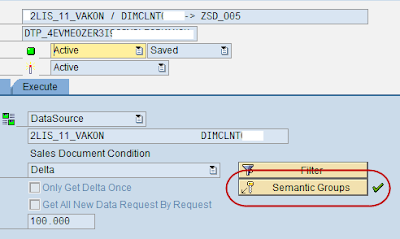
The process that took the significant ammount of storage is caused by ‘Semantic Groups’ technique. The ‘Semantic Groups’ feature will first gather all the information based on primary key / groups primary key to sort all the records across the packet.
Option for solution, workaround:
1.Extend PSAPTEMP
2.Turn Off the ‘Semantic Groups’ feature in DTP. This will do the work also without extend the PSAPTEMP.
The consequence of turning off the ‘Semantic Groups’ is that you might be end up with fixing a lot of unqualified data despite those records have same key(primer key) or group key.

Managing Query in SAP BW NW7 can be done with theese tools and t-code:
Note for Deleting Query
Deleting Query can be easily done by using this t-code: RSZDELETE or using Query Designer, but sometimes problem just happen.
Problem / Symptom that migght happen when Deleting query with RSZDELETE:
The Query Cannot be deleted from Query Designer or SAP GUI (with RSZDELETE). It just keep showing error / warning message “ Query Block” on SAP GUI interface. If we delete the Query from Query Designer, the query seems deleted but if logoff and log on BEX again the query magically appear.
So, what we have to do then? Both RSZDELETE and Query Designer cannot delete the Query.
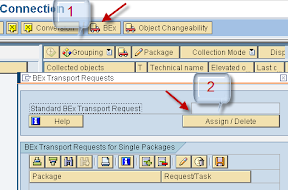
Log on to SAP GUI > RSA1 > Transport Connection Menu.We have to set the query to the Bex Transport Request. Note that there are two kind of transport (Transport and Bex Transport). Build a new Bex Requset transport, by clicking the icon with pictures of a ‘car’ and ‘BEx’. Then Click ‘Assingn / Delete ‘, create ‘new request’ …. done!
and the query should be deleted easily. Good Luck
After getting to know and familiar with SAP BW basic T-CODES. I found another website to help mastering SAP BW is http://sap.seo-gym.com/.
Lots of goodies relating SAP BW, such as tutorials, learning guides and help files containing PDF or Microsoft Documents (Doc) .
Interesting, I thought the page/sub domain is a technic for Search Engine Optimation(SEO), and it works!
Theese are the list of tutorial that i copy paste from sap.seo-gym.com
 Problem:
Cannot delete Data Transfer Process (DTP) from DSO/CUBE to DSO/CUBE. Despite all the pre-conditions have been met, such as deleting data and requests in the target and source.
Error Message:
Delta DTP cannot currently be deleted (see long text)
Message no. RSBK037
Diagnosis
You want to delete a delta DTP that has been successfully used to load requests from the source into the target. If you delete the DTP, you will also delete the information on the source data that was successfully transferred. As a result the source data would be transferred again, if you create a new delta DTP that links the same source with the same target.
Procedure
You have two options:
1. Delete all the requests loaded with this DTP from the target and then delete the DTP.
2. Do not delete the DTP and continue to load deltas using this DTP.
Solution:
Go To Transaction RSBKDTP to delete DTP directly.
Source: http://forums.sdn.sap.com/thread.jspa?threadID=1568522&messageID=8581401
Additional Note:
Data Transfer Process (DTP) is related to various object such as Target, Source and Transformation. Here’s an extra table check for transformation. After deleting DTP, Cube or DSO than the transformation should be deleted too.
RSTRAN Transformation
RSTRANFIELD Mapping of Rule Parameters – Structure Fields
RSTRANRULE Transformation Rule
RSTRANSTEPROUT Rule Type: Routine
RSTRANRULESTEP Rule Steps for a Transformation Rule
RSTRANSTEPMAP Mapping for Rule Step Within a Rule
Source:http://www.sapks.com/2010/01/dtp-tables.html
With UD Connect you can now integrate the data for the source object into SAP BW. You can either extract the data, load it into SAP BW and physically store it there, or, as long as the prerequisites for this are fulfilled, you can read the data directly in the source using a SAP RemoteCube. Example SQL Server 2008…
But, when we tries to extract data from SQL Server 2008 x64 database to SAP BW NW7 with UD Connect , we get an error message.
The error message when executing an Info Package to load/transfer data from SQL Server 2008 x64 to SAP BW NW7.
S:RSSDK:400 Cannot convert field DECIMALS of type NUM to int
to solve the problem you have to check the SQl Server “Unicode” Setting
Steps:
1.) Go to SAP BW > RSA1 > Source System > UD Connect > ….
Right Clik on the UD connection name and Click on Connection Param.

3.) Go to MDMP & Unicode Tab and Run Unicode Test you must have access to TCODE SM59
4.) If your target system is Unicode, then you have to tick Unicode for Communication Type for Target System.
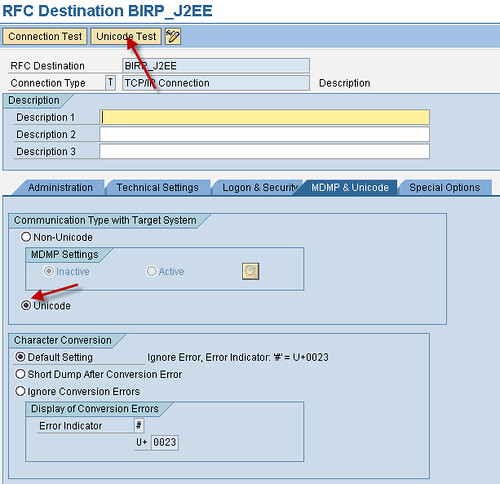
5.) Save and Close the Source System Dialog
6. )re Run the Execution of Info package.
Good Luck
First, if there is an error on the activation of a DataSource Object (DSO) or the Transfer Rule Object.
Run this transaction code:
RSRV: Analysis and Repair of BW Objects
Second, If an SAP BW InfoObject get an enhancement then it should be repaired too. Apply these steps:
Run this transaction code:
RSA1 :
Goto Top Menu and follow these steps:
Tools – Apply Hierarchy / Attribute Changes
SAP BW Client
– SBIW : SAP Business Information Warehouse IMG (Implementation Guide)
– RSA1 : Modelling DW Workbench. This is Main Transaction
– SCC4 : Client Administration (BASIS Area)
– RSECADMIN : Authorization, Replacing Obselete RSSM
– SE10 : Transport Organizer
– RSPC : Process Chain Maintenance
– SE37 : ABAP Function Modules
– RSZC : Copy Query Between InfoCube
– RSRV : Analysis and Repair of BW Objects
– RSORBCT : BI Business Content Transfer
– SM37 : Overview Of Job Selection
– LISTCUBE: To display content of Info Providers
SAP R3 Client (Origin, Dev, or Quality Control)
– RSA9 : Content Application Transfer Component Hierarchy (One Time Setting)
– RSA2 : OLTP Metadata Repository, For Checking DELTA Capable
– RSA3 : Extractor Checker
– RSA 5 : Install Business Content
– RSA6 : Maintain DataSource
– RSA7 : BW Delta Queue Monitor
– LBWQ : Logistic Queue Overview
– LBWE : LO data Extraction : Customizing Cockpit
– LBWG : Deletion of Setup Data
– SBIW : SAP Business Information Warehouse IMG (Implementation Guide)
– OLI7BW : Statistical Setup for Old Documents : Order
– SE16 : Data Brrowser
– SE10 : Transport Organizer
– SE11 : ABAP Dictionary Maintenance
– RSO2 : OLTP Metadata Repository
SAP ERP is the flagship ERP solution from the third largest software company in the world. So it has to be good, right?
That’s the marketing hype, but does that mean that SAP ERP is good for the particular needs of your organization? Because at the end of the day, that’s what really matters.
And now it’s easy for you to find out.
Simply use TEC’s Evaluation Tools
to compare SAP ERP against two other ERP solutions of your choice.
not just ERP , but also other solution (BI,CMS,BPM, etc..)